

- A key is the tag name you group spend by, such as
teamorenvironment. - A rule describes which resources take a given value for that key.
Create a tag key
Open Settings > Virtual tags and choose Create new tag.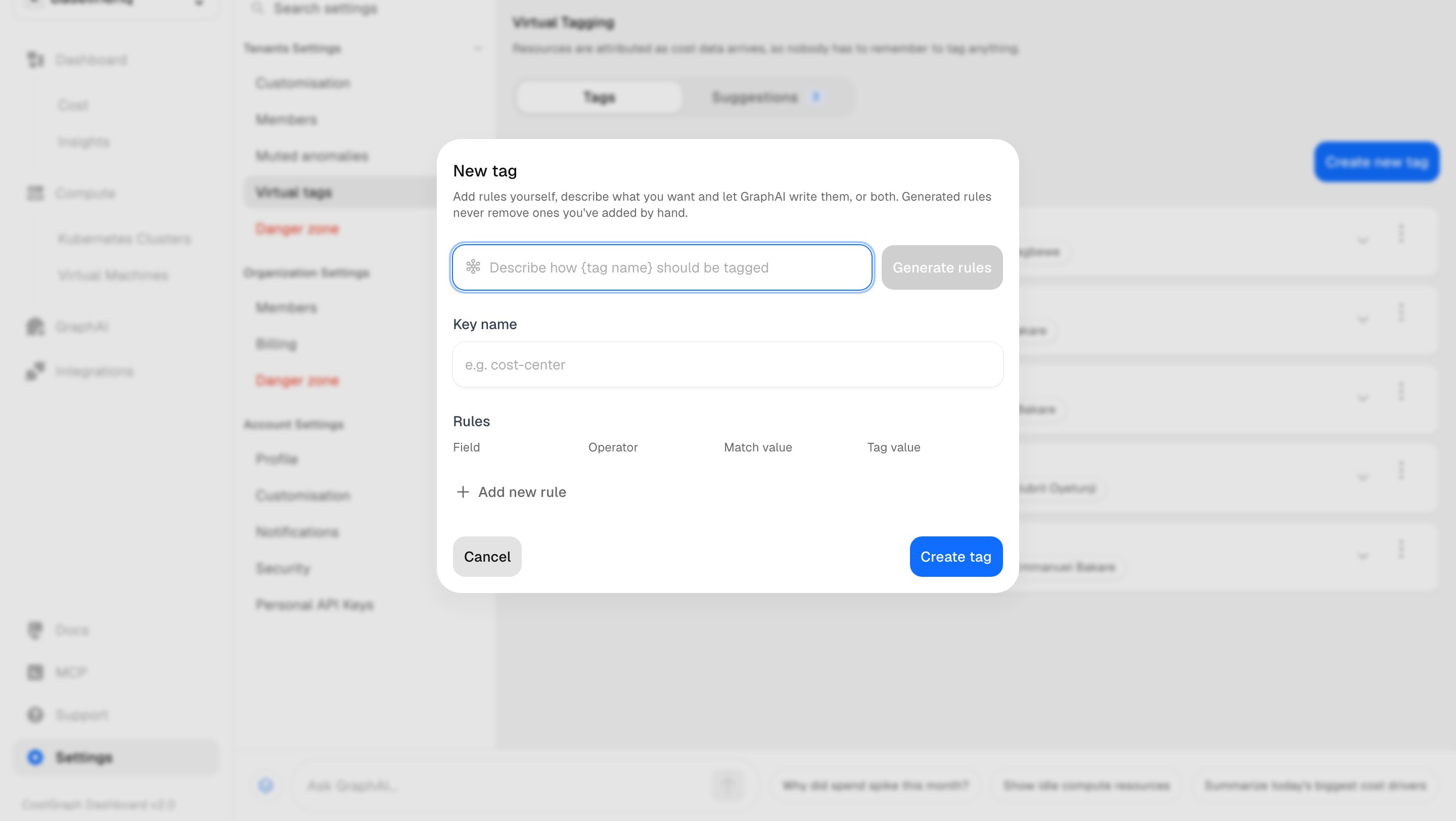
1
Name the key
Give the key the name you want to group spend by, such as
team or
cost-center.2
Add rules, or describe them
Add rules yourself, or describe in plain English how the tag is to be
applied and let Graph AI generate them. You can do both: generated rules
never remove the ones you add by hand.
3
Create the tag
Choose Create tag. A key on its own claims nothing; it starts allocating
spend once it has rules.
Write a rule
A rule reads left to right: a Field, an Operator, a Match value, and the Tag value it assigns when the rule matches.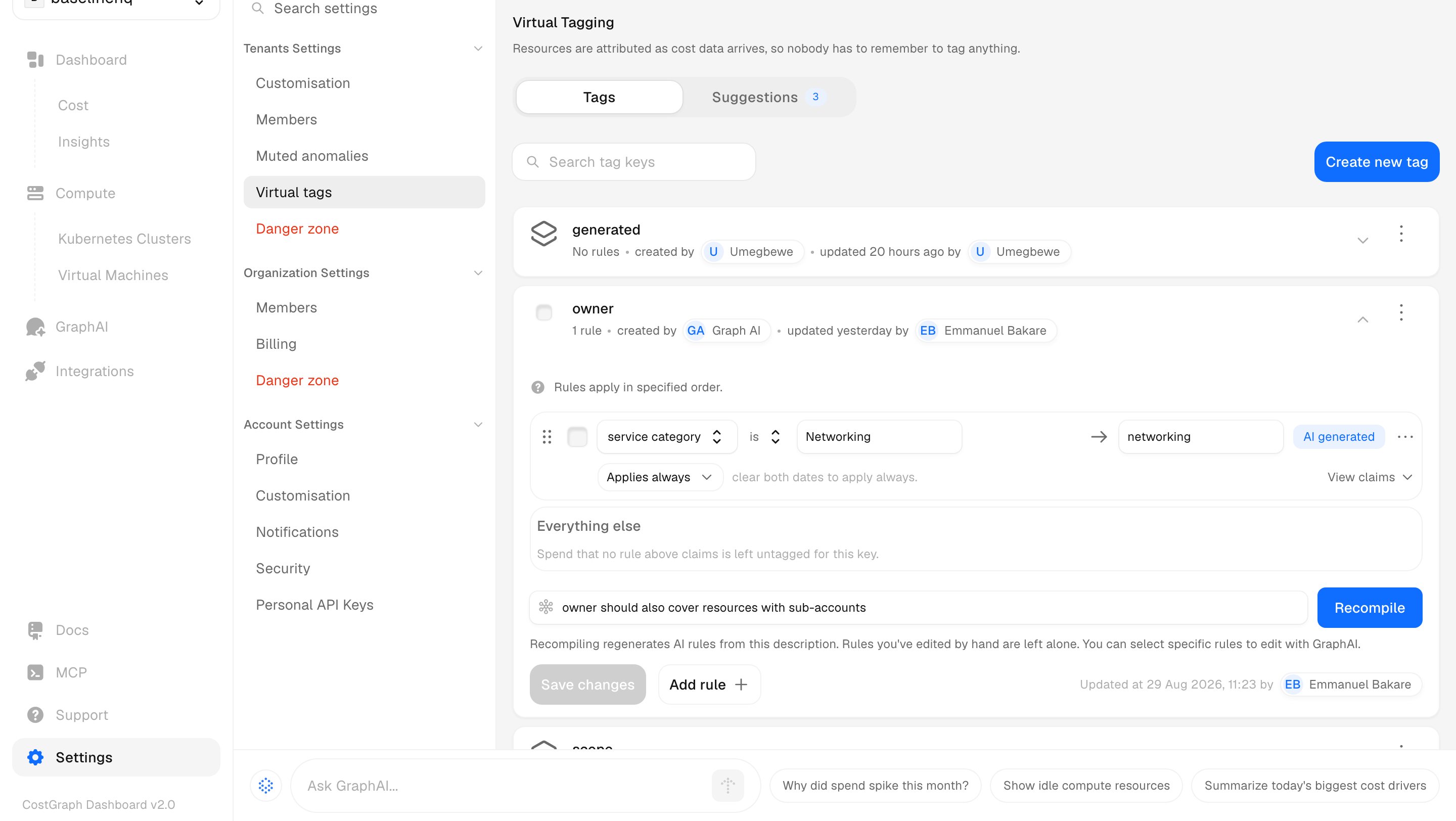
Match resources
Each condition is a field, an operator, and a value to match against:
Conditions combine with and, or, and not, so a rule can be as broad
or as precise as you need. For example, set the tag value
observability-metrics
when the provider is datadog and the service is Metrics.
You can match on the resource’s own attributes, such as service category,
provider, and region, and on the cloud tags already attached to it.
Assign a value
The Tag value is what the key is set to when the rule matches, such asdata-platform. A rule can instead inherit its value from a cloud tag already on
the resource, so where a team already tags with owner, a virtual tag can reuse
that value rather than restating it.
Scope it to a date range
A rule applies always by default. Give it a date range to cover only a period, or hand a key from one value to another on a set date. This is how you keep history correct through a reorg or a rename.Preview what a rule claims
Each rule has a View claims control. Before you save, it shows exactly what the rule would claim: how many line items it matches and how much spend. This is the fastest way to tell whether a rule is too broad or too narrow before it affects any report.If View claims shows nothing, the rule matches no spend yet. Widen a condition,
or check the field values against what your resources actually carry.
Overlapping rules
Shared resources are the whole reason virtual tags exist, so more than one rule under a key can match the same resource. Rules under a key are ordered, and the first rule that matches wins. Reorder your rules to control which value a shared resource takes. Because the outcome is decided by order rather than left ambiguous, a cluster several teams could claim resolves predictably. Every key ends with an Everything else row. Spend that no rule above it claims is left untagged for that key, so you can always see how much is still unattributed.Pause or remove a rule
Pause
Stop a rule from claiming without deleting it. Its place in the order is
kept, so you can switch it back on later.
Delete
Remove a rule entirely. Resources only that rule claimed become unallocated
for the key until another rule covers them.
Analyze spend by the tag
Once a key has rules, it behaves like any other dimension. Group and filter your cost views by the key alongside native dimensions such as service and region, and compare owners the same way you would compare services or regions.Next steps
Graph AI
Generate tag rules by describing what you want in plain English.